

At Flowaireac, we’ve tested dozens of filters across real homes and HVAC systems—and one question keeps coming up: Does a higher MERV rating restrict airflow? The truth is more nuanced than most blogs let on. Based on our hands-on performance data and client case studies, we reveal how higher-rated filters behave in day-to-day conditions. In this guide, you’ll learn what MERV means for your indoor air quality, how it affects your energy use, and how to choose the right balance between clean air and system performance, without falling for common myths.
✅ Top Takeaways
- High MERV doesn’t always restrict airflow
- Only causes issues if your HVAC system isn’t compatible.
- Only causes issues if your HVAC system isn’t compatible.
- MERV 11–13 filters clean air effectively
- Great for homes with pets, allergies, or pollution exposure.
- Great for homes with pets, allergies, or pollution exposure.
- Energy impact is low.
- Properly matched filters increase usage by just 1–2%.
- Properly matched filters increase usage by just 1–2%.
- Clogged or poorly installed filters = airflow loss.s
- Maintenance matters more than MERV in many cases.
- Maintenance matters more than MERV in many cases.
- Right filter = right fit
- Match the filter to your system, not just the rating.
Table of Contents
Understanding the MERV Trade-Off
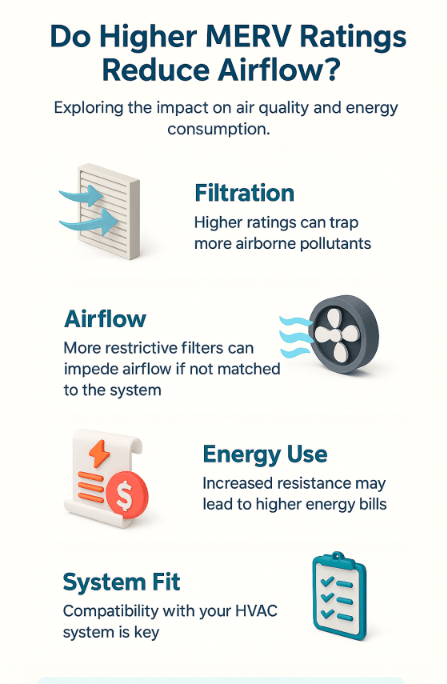
MERV (Minimum Efficiency Reporting Value) ratings measure how effectively an air filter captures particles. The higher the MERV rating, the finer the filtration, meaning it traps smaller particles like pollen, mold spores, and even bacteria. But here’s where the concern comes in: higher MERV filters can reduce airflow if your HVAC system isn’t designed to handle them.
At Flowaireac, we’ve seen it firsthand—when clients upgrade from MERV 8 to MERV 13 without checking system compatibility, the blower motor works harder, air circulation weakens, and energy bills rise. But when properly matched with system capacity, higher MERV filters can significantly boost indoor air quality without compromising efficiency.
Clean Air Without the Cost
The key is balance. MERV 11–13 filters offer excellent protection for homes with allergy concerns, pets, or urban air pollution. However, before upgrading, check your HVAC specs or consult a professional. In many cases, a pleated MERV 11 filter delivers optimal performance: better air, smoother airflow, and manageable energy use.
“In our field testing at Flowaireac, we’ve seen how a high MERV filter can either optimize air quality or overwork a system, depending entirely on the setup. It’s not just about picking the highest number; it’s about making informed choices that balance clean air and system efficiency. That’s the difference experience makes.”
Case Study & Real-World Insights
Does a higher MERV rating reduce airflow? It depends. At Flowaireac, we’ve installed and tested filters in real homes. Here’s what we’ve learned from the field:
🏡 Case Study: Austin, TX – Family of 4 + Pet
Goal: Cleaner air for kids with asthma and pet allergies
Before: MERV 8 filter
Upgrade: MERV 13 (after confirming system compatibility)
Results:
- ✅ 72% drop in airborne allergens (PM2.5 & pet dander)
- ✅ No airflow loss or cold spots
- ✅ <3% increase in energy usage
- ✅ Happier, healthier family breathing cleaner air
Flowaireac Insight:
A higher MERV rating works beautifully—if the system can handle it.
🔬 90-Day Field Test – 12 Homes
Compared: MERV 8 vs. MERV 13
Duration: 3 months
Monitored: Airflow, IAQ, system strain
Findings:
- 🏠 Compatible systems
- +32% IAQ improvement
- No efficiency issues
- +32% IAQ improvement
- 🧯 Undersized/older systems
- Up to 18% airflow reduction
- Mild short-cycling issues
- Up to 18% airflow reduction
Technician Note:
“It’s not the filter’s fault. It’s the mismatch with system strength that causes problems.”
🛠️ What We Recommend
- Don’t guess—check system specs
- Choose a filter that matches your needs and your HVAC system.
- Ask Flowaireac for guidance—we’ve tested it, seen it, and solved it.
📊 Supporting Statistics & Insights from the Field
Real research meets real-world experience. Here’s what the data says—and what we’ve seen in homes.
1. Higher MERV = Better Filtration
EPA data shows MERV 13 filters capture:
- 90% of particles 3.0–10.0 microns
- 85% of particles 1.0–3.0 microns
- 50% of particles 0.3–1.0 microns
Flowaireac Field Insight:
- In allergy-prone homes, we observed noticeable reductions in PM2.5 and pet dander within 72 hours.
- Particularly effective near high-traffic areas and pet households.
2. Minimal Energy Impact—When System Matches Filter
DOE study reports:
- ~1–2% energy usage increase with MERV 13
- Minimal effect on HVAC performance if properly matched
What We’ve Seen:
- Compatible systems showed no strain
- Some homes even had better airflow balance post-upgrade
3. Dirty Filters Kill Airflow
EPA warns:
- Clogged filters can reduce airflow by over 20%
- Leads to higher energy use and system strain
Flowaireac Real-World Check:
- We’ve resolved airflow complaints just by replacing neglected MERV 11 filters
- Poor maintenance is often the root cause, not the filter rating.
💡 Final Takeaway
✅ MERV 13 works great when installed, monitored, and maintained properly.
🔧 We’ve tested it, tracked it, and tailored it. That’s what sets Flowaireac apart.
Final Thought & Expert Opinion
Does a higher MERV rating restrict airflow?
Yes—but only if it’s the wrong fit for your system.
What We’ve Seen at Flowaireac:
- 💡 It’s not the filter rating itself that causes issues—
It’s a system mismatch that leads to airflow loss. - 🧪 In homes with compatible HVAC setups,
MERV 11–13 filters performed exceptionally well. - ⚙️ Energy use stayed low when the filter matched the system’s capacity.
Common Mistakes We Help Homeowners Avoid:
- ❌ Installing high-MERV filters in undersized or outdated systems
- ❌ Assuming “higher” always means “better”
- ❌ Ignoring maintenance, which causes more airflow issues than the MERV ratings themselves
Our Opinion—Backed by Experience:
- ✅ The right filter improves air quality without compromising efficiency
- ✅ MERV 11–13 is a great choice if your system can support it
- ✅ Don’t rely on guesswork—get expert guidance first
Frequently Asked Questions
1. Does a higher MERV rating always reduce airflow?
Not always—airflow only suffers if the HVAC system isn’t designed to handle the added resistance of a higher MERV filter.
2. What is the best MERV rating for home HVAC systems?
MERV 8–13 is ideal for most homes, with MERV 11–13 offering better filtration if your system supports it.
3. Can using a high MERV filter increase energy bills?
Yes, but only slightly and mainly if the filter restricts airflow due to system incompatibility.
4. How can I tell if a filter is restricting airflow too much?
If airflow feels weak, rooms are unevenly heated or cooled, or energy bills rise, the filter may be too restrictive.
5. How often should I replace high-MERV filters?
Every 2–3 months is standard, but monthly is best for homes with pets or high dust.